

Multi-tenant client area and back office
An enterprise product by Fiper Tech Group for brokers, banks, financing companies and funded trading firms: every tenant gets a client area under its own brand, a role-based back office and an owner panel. What you read here comes from the product's own documents; the public preview runs on labelled simulated data.
Technically ready — real integrations deferred Simulated data Per the product's documents
Who it is for
Licensed brokerages, banks and their investment arms, financing companies and funded trading firms that need a client area and a back office under their own name, not the platform provider's. Every tenant is isolated at the row level of the database, with its own identity, legal texts and rules.
Capabilities — from the product's documents
Sixteen modules
From registration and staged identity verification to trading accounts, deposits and two-person withdrawals, partners, copy trading, chat and lead intake; the vendor switches on what each tenant needs.
Sixteen hardening controls
Attempt limits, server-side sessions, two-factor authentication, a hash-chained audit log that is verified, a daily backup with a recorded restore exercise, a permission matrix measured in every integration run, and a dynamic scan of the public surface — each control with a computed status on the owner's screen.
White label per tenant
Logos, colours, fonts and category-only legal texts per tenant, with a live preview before saving; no third-party logos.
Export and transfer
A full export of a tenant's data in a format that imports into another copy with the audit chain verified, and a written ownership-transfer plan from day one; plus an import from the current system with a column-mapping wizard, a dry run and a rollback.
Per-tenant deployment
A tenant is recognised by its host or its path and is provisioned from the vendor panel with one wizard; production and a tenant's domain follow a recorded decision.
Modules
As in the product's module registry; the real platforms, the identity-verification provider and e-mail are integrations deferred until the sandbox keys arrive.
The client-area foundation
- Tenancy and row-level isolation
- White-label branding per tenant
- Client registration, verification and sign-in
- Profile and the unified client file
- Documents
- Tickets
- In-app notifications
- Protected audit log
Operations, money and partnerships
- Roles: admin, compliance, support, finance
- Staged identity verification with the compliance queue
- Trading accounts through the platform adapter
- Deposits and two-person withdrawals
- Partners (IB) and the commissions engine
- Copy trading
- Client chat with support
- Lead intake
Hardening controls
Per the product's security-posture document; the status is computed from real signals, never typed in.
Surface and access protection
- Attempt limits, temporary lockout and a honeypot
- Server-side sessions and re-authentication before sensitive actions
- Metadata stripping of uploads and an antivirus seat
- Security headers and a per-request content-security nonce
- A permission matrix measured in every integration run
- Audit export and chain verification
- A dynamic scan of the public surface
- Dependency audit
Verification and continuity
- A security-posture document and a penetration-test scope
- The owner's security screen
- Two-factor authentication with app codes and recovery codes
- An independent maintenance role and a non-owner application role
- Incremental audit-chain verification with checkpoints
- Full export and import with a transfer test
- A daily backup and a recorded restore exercise
- Daily reconciliation of pending deposits
Screens from the preview
Captures of the public preview at phone width; everything in them is labelled simulated data.
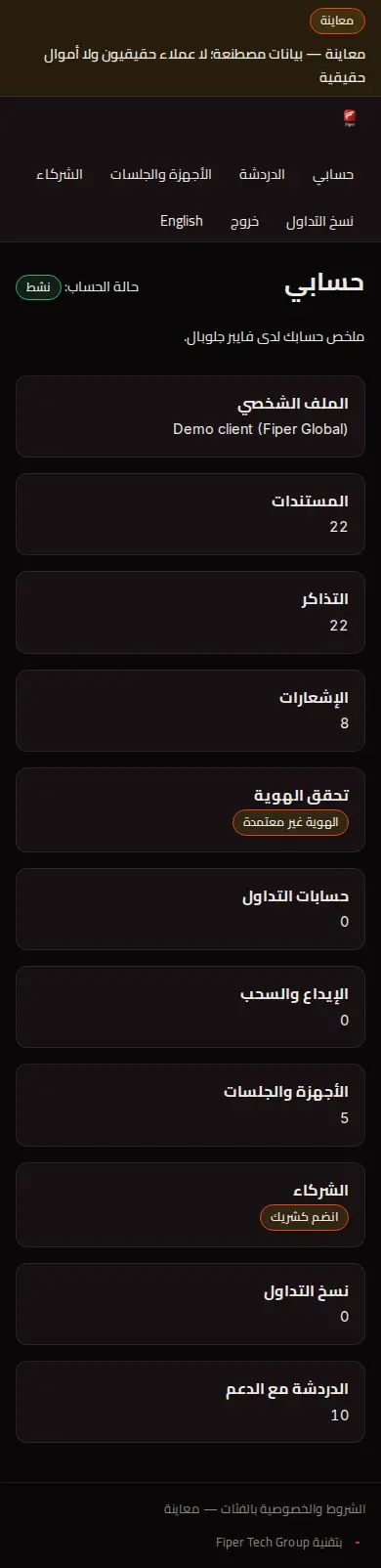
Simulated data Client dashboard 
Simulated data Back office — clients 
Simulated data Tenant owner panel 
Simulated data Security screen
What is not ready yet
The real integrations — trading platforms, the identity-verification provider, e-mail and the payment gateway — are deferred until the sandbox keys arrive; payment in the preview is simulated; no real data before an external penetration test and a launch decision. «Technically ready» does not mean commercially ready.
Request a demo
Leave your company's details and we come back to you to show the product on your assumptions. No commitment.